|
 GLADIATOR
 |
|
|
|
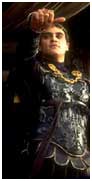 A
Roman gladiator stands at the center of the great Colosseum looking up
at the emperor, awaiting his decision. With the power of life or death,
the emperor's thumb is outstretched, and the monarch's expression unforgiving.
He appears poised to signal the gladiator to kill his defeated opponent.
This was the scene, captured in the painting Pollice Verso (translation:
Thumbs Down) by the 19th-century artist Jean-Leon Gerome that fired the
imagination of director Ridley Scott and put him at the helm of the epic
action drama "Gladiator." A
Roman gladiator stands at the center of the great Colosseum looking up
at the emperor, awaiting his decision. With the power of life or death,
the emperor's thumb is outstretched, and the monarch's expression unforgiving.
He appears poised to signal the gladiator to kill his defeated opponent.
This was the scene, captured in the painting Pollice Verso (translation:
Thumbs Down) by the 19th-century artist Jean-Leon Gerome that fired the
imagination of director Ridley Scott and put him at the helm of the epic
action drama "Gladiator."
Executive producer
and co-head of DreamWorks Pictures Walter Parkes, along with producer
Douglas Wick, showed Scott the painting even before giving him the script.
Scott recalls, "Walter and Doug came by my office and laid a reproduction
of the painting on my desk. That image spoke to me of the Roman Empire
in all its glory and wickedness. I knew right then and there I was hooked."
|
| |
| Fortunately
for the director, Parkes also had a screenplay entitled "Gladiator," written
by David Franzoni, John Logan and William Nicholson. Wick offers, "About
two years ago, David Franzoni came to me wanting to do a movie set in ancient
Rome. We started doing the research and discovered that almost every aspect
of the culture revolved around the arena. It was at the epicenter of all
levels of society, and, in support of it, huge breakthroughs were made in
architecture, in metalwork, in drainage…almost everything imaginable. The
more we learned, the more convinced we were that the arena would be an amazing
place to set a story." |
| |
"Starting
from that very rough idea, we set out to create a hero who could take the
audience on an 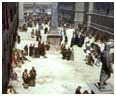 emotional
journey through this amazing milieu," Parkes adds. "As the script came together,
we realized the real challenge would be to find a filmmaker who could deal
with the sheer physical size and spectacle of the movie with such mastery
that the essential elements of character and story would not be overpowered
by the setting. From the start, Ridley Scott was at the top of our list."
Scott notes, "Entertainment has frequently been used as a tool of leaders
as a means to distract an abused citizenry. The most tyrannical ruler must
still beguile his people even as he brutalizes them. The gladiatorial games
were such a distraction. Our story suggests that, should a hero arise out
of the carnage of the arena, his popularity would give him tremendous power…and
were he to be a genuine champion of the people, he might threaten even the
most absolute tyrant." emotional
journey through this amazing milieu," Parkes adds. "As the script came together,
we realized the real challenge would be to find a filmmaker who could deal
with the sheer physical size and spectacle of the movie with such mastery
that the essential elements of character and story would not be overpowered
by the setting. From the start, Ridley Scott was at the top of our list."
Scott notes, "Entertainment has frequently been used as a tool of leaders
as a means to distract an abused citizenry. The most tyrannical ruler must
still beguile his people even as he brutalizes them. The gladiatorial games
were such a distraction. Our story suggests that, should a hero arise out
of the carnage of the arena, his popularity would give him tremendous power…and
were he to be a genuine champion of the people, he might threaten even the
most absolute tyrant." |
| |
| Despite
his enthusiasm for the project, Scott was aware that he was venturing into
a genre whose popularity had not been tested in this generation. "'Spartacus'
was 40 years ago," the director observes. "'Ben Hur' before that. These
movies were part of my cinema-going youth, but at the dawn of a new millennium,
I thought this might be the ideal time to revisit what may have been the
most important period of the last two thousand years, if not in all of recorded
history: the apex and the beginning of the decline of the greatest military
and political power the world has ever known." |
| |
| from:
Gladiator
Website |
|
|
|
© 2000
IHTML & Maria Jose All Rights Reserved.
|